 Meshbell
No tower.
No router.
Still on the air.
Meshbell carries signed emergency bulletins across a neighborhood on low power radio. Your phone checks each one itself, offline, and says plainly what it could not verify.
no cell · no internet · no account
Example bulletin
rcvd 14:22:07
rssi -96 dBm
size 172 B
snr +7.5 dB
sf7 · bw 62.5 kHz · cr 4/5
Evacuation order. Zone 4, west of the river. Leave now by Ridge Rd.
Signature verified on this device
An example, not a live alert. It shows what a Meshbell message is: the same record twice, the machine's and yours.
Signal path
How a warning gets to your street.
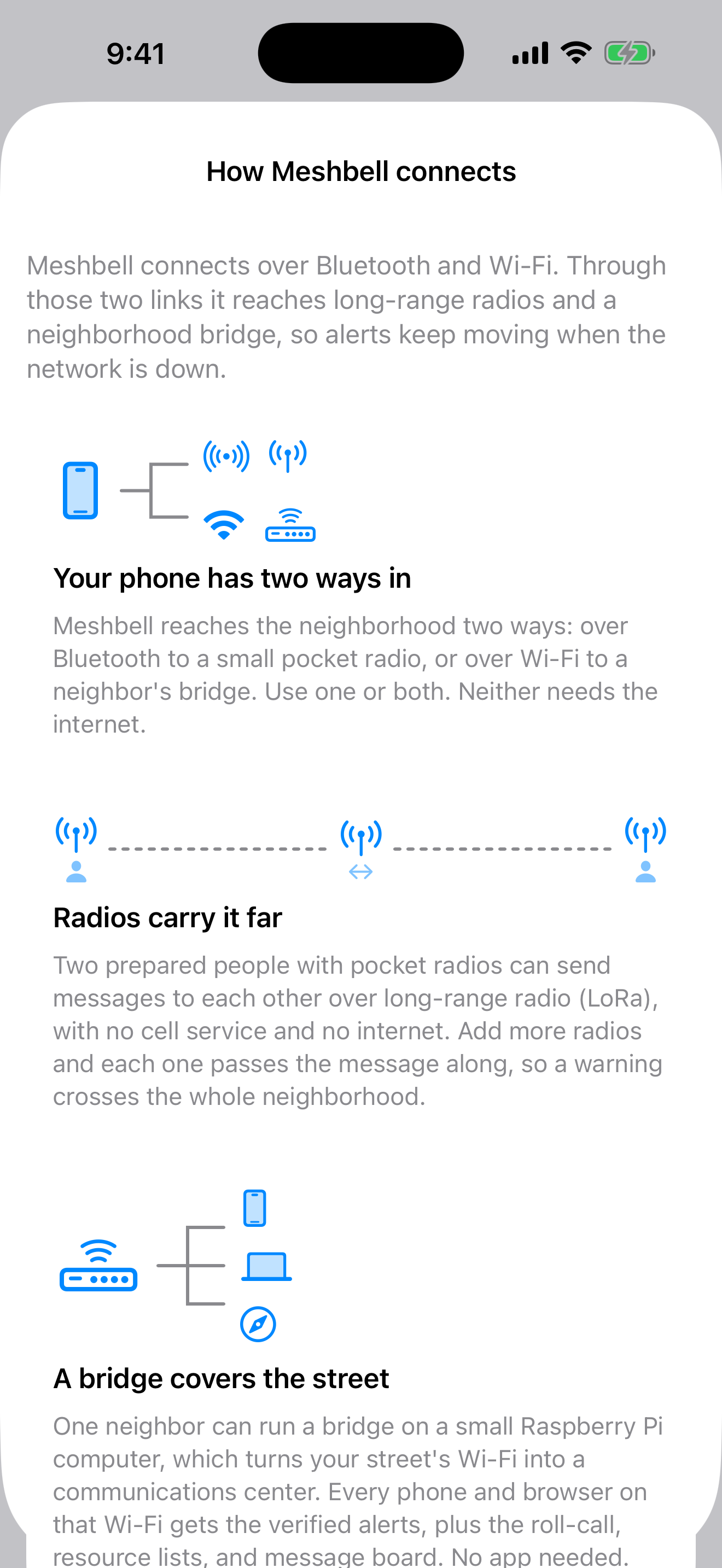
Five stations and four legs. Read the medium on each leg, because the medium is the lesson.
-
Station 1
Your phone
Writes or receives the bulletin, and checks the signature itself.
-
bluetooth le · 2.4 GHz · one phone at a time
The phone hands it to the radio in your bag.
-
Station 2
Pocket radio
A LoRa node, about $30. No SIM, no account, no subscription.
-
lora · 910.525 MHz · sf7 · 172 B
Long, slow, low power. It reaches far because it goes slowly, and it moves in hops, not in a stream.
-
Station 3
Neighbors' radios
Each one repeats it once and then stops, so the air stays clear.
-
lora · hop to hop
Across blocks and over a ridgeline, with nothing in between. Built to relay. The bench has proven one hop.
-
Station 4
The bridge
One neighbor's Raspberry Pi. It holds the record and serves it over Wi-Fi.
-
wi-fi · lan · no uplink needed
A local network that needs no way out. If one happens to exist, the bridge will use it.
-
Station 5
The block
Any phone or browser nearby. Every device checks the signature again, on its own.
the room
a household
a street
across blocks, over a ridgeline
reach, not to scale. no distance on this page is bench measured.
-
Just a phone
Reaches station 1, and station 5 when a neighbor's bridge is in range. Official alerts arrive over the internet when there is one, and over that bridge's Wi-Fi when there is not. A phone on its own never hears LoRa.
-
Plus a radio
Stations 1 through 3. You are on the air: sending and hearing bulletins with no cell and no internet.
-
Plus a bridge
The whole chain, including the neighbors who have only a browser.
Your phone has no long range radio inside it. This one does.
Two prepared people, each with a pocket radio, can reach each other with no network at all. That is level 1 on the ladder below.
A neighbor with only a browser reaches the same records. No app needed.
nothing in this path touches a tower, a router, or an account
Why we built it
Two things fail in the first hour.
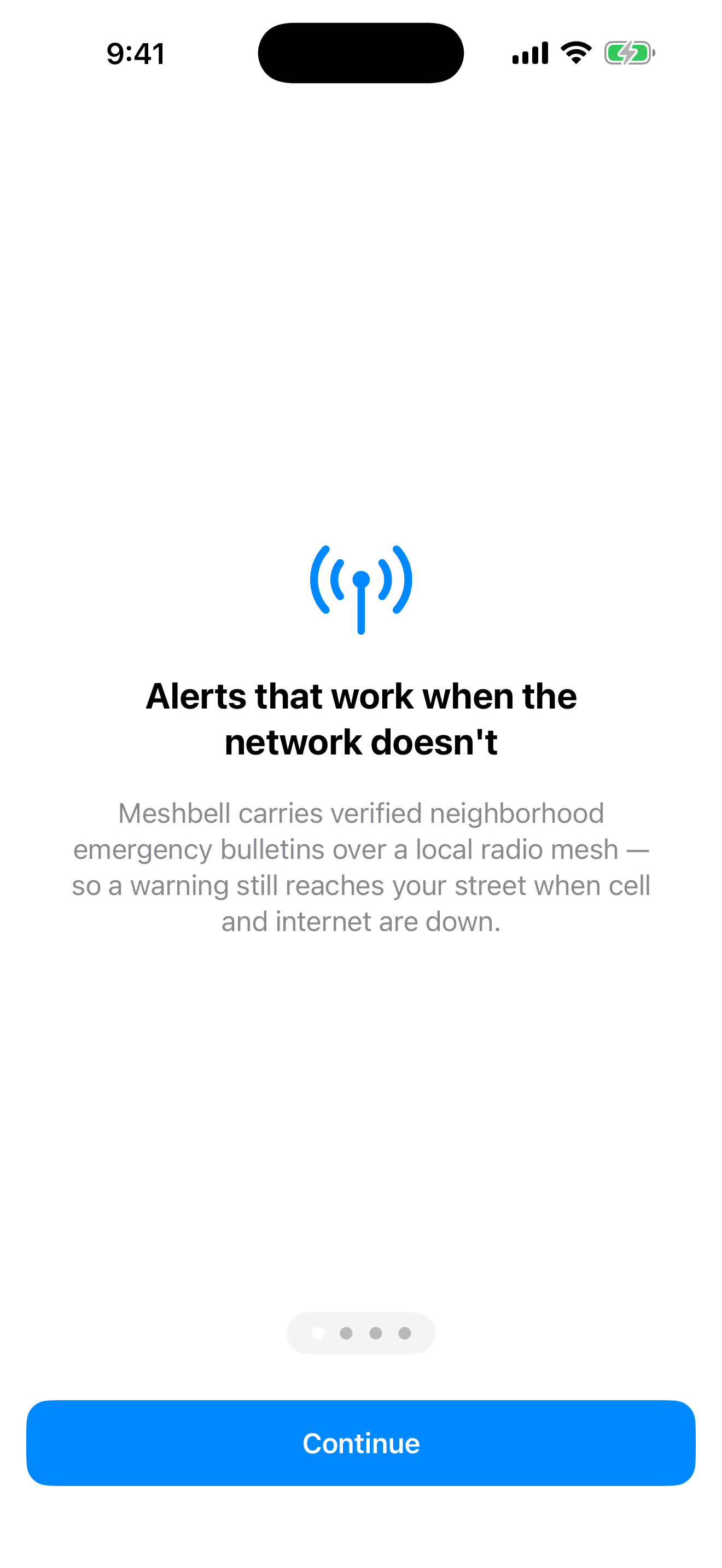
The first is the network. Floods, fires and long outages take cell towers and home internet with them, at the exact hour a neighborhood needs to talk to itself. Meshbell does not depend on either one.
The second is harder. Here is the shape of it. A photo goes around during a flood. The caption names a building that is not the building in the photo. By the time anyone corrects it, a few hundred people have already decided where the hospital is, and some of them have started driving.
"Hospital is open, take the river road."
Example · Could not be verified
Meshbell will show you that message. It will not let it look like an order. The app holds two facts apart and prints both: who is speaking, and whether this device could check them.
The app never launders a rumor into an instruction.
That is not a policy someone remembers to follow. It is the shape of the code. A screen that renders an instruction cannot be built out of a message that failed the check, and guidance text comes from a bundled playbook keyed by id, never from free text on the wire.
Ways to prepare
Start where you are.
Meshbell grows with your equipment. Every level tells you plainly what it can and cannot do.
-
level
Needs internetJust your phone
Verified official alerts for the places you follow, checked on your own device. When the network drops you keep the last verified data, labeled with its age instead of a confident blank.
phone only · free
For everyone. Nothing to buy, nothing to set up.
-
level
Works offlinePhone plus one radio
Send and hear neighborhood bulletins with no cell and no internet. Two prepared people, each with a pocket radio, can reach each other at long range with nothing in between. Reach is a household and a street, which is most of what you need on the first night.
+ 1 lora node · ~$30
For one prepared person or family.
-
level
Works offlineA few radios on the block
Three or more radios begin real multi-hop reach, across blocks and over a ridgeline. Built to relay. The bench has proven a single hop, and the rest is designed, not measured.
3+ nodes · ~$30 each
For a handful of neighbors who set them up together.
-
level
Works offlineAdd a Wi-Fi bridge
Neighbors with only a browser see the verified feed. The bridge also carries the coordination layer: a roll-call, shared lists, a board, and a one page printout for when phones die. The installer ships inside the app.
+ raspberry pi · ~$50-80
For a block captain or one willing host.
-
level
Works offlineA full neighborhood mesh
Signed alerts and the coordination layer at neighborhood scale, with no cell and no internet. Neighbors enroll each other's keys in person, so trust is real and there is no directory of who lives where.
nodes + bridge + in-person keys
For an organized neighborhood or mutual-aid group.
How many radios does a block need? The app estimates it from your area's size and density, and the hardware guide lists the parts.
Spec sheet
What it does today.
- places
Follow your places
Add your home, or a family member's street. Serious verified hazards that touch them reach your lock screen. The rest stays in the feed.
- neighborhood
The Neighborhood tab
Check in safe, share resource lists, post to the board. Native in the app over your street's bridge. No browser, no account.
- search
One field over everything
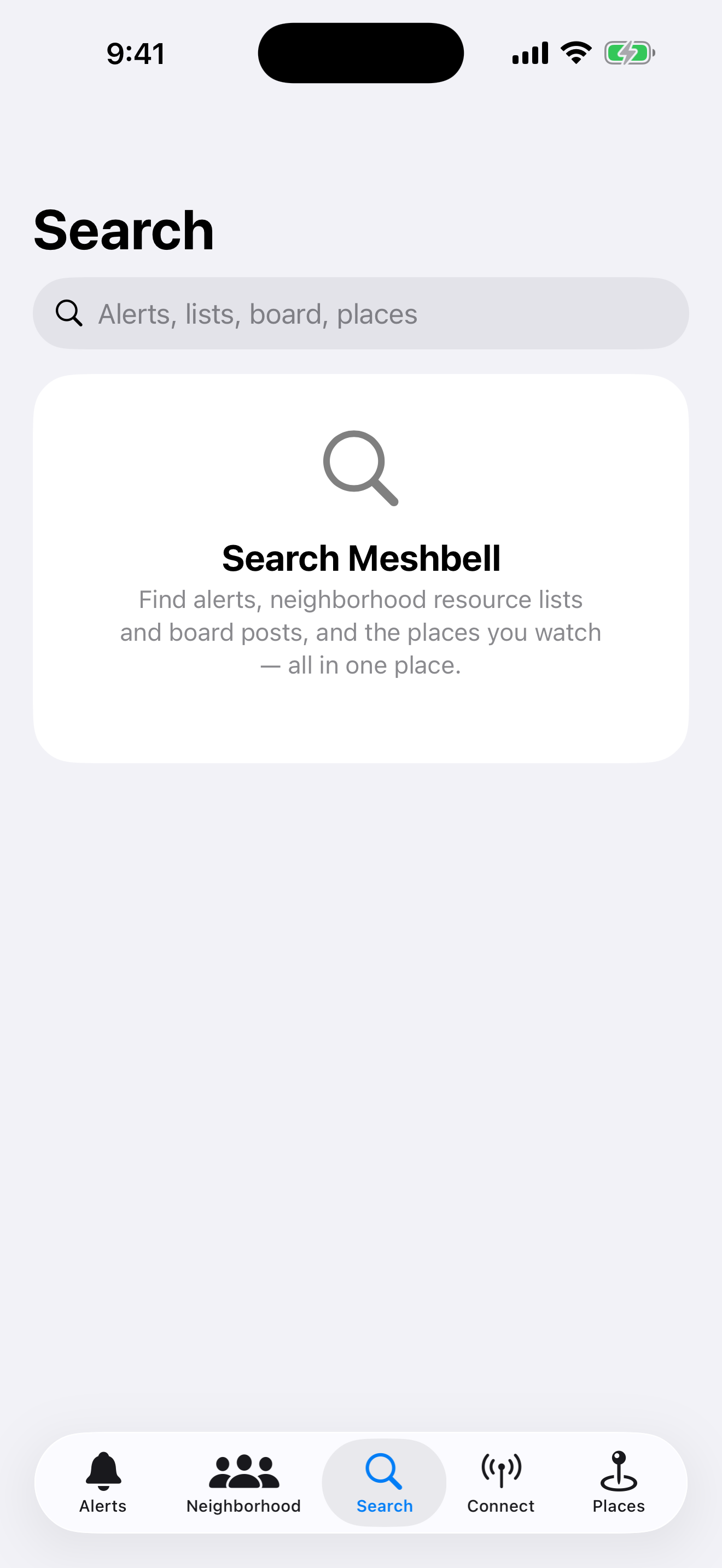
Alerts, the board, resource lists and your places in a single search, so you can find the shelter list without scrolling the feed.
- verify
Checked here, not there
Your phone holds the signature math itself, so nothing on the network gets to say what is true. A bulletin that clears the check says so. One that cannot is labeled unverified and never gets to sound like an instruction, no matter who relayed it.
- enrollment
Meet a neighbor's key
Enroll each other in person: scan a QR code, read a short fingerprint aloud. That is the whole security model, and it builds no directory of who lives where.
- bridge
Bridge the block
The bridge installer ships inside the app. Guided setup stands it up on a Raspberry Pi, and the app finds it on the Wi-Fi by itself. There is a manual address field for networks that block discovery.
- link
A link that repairs itself
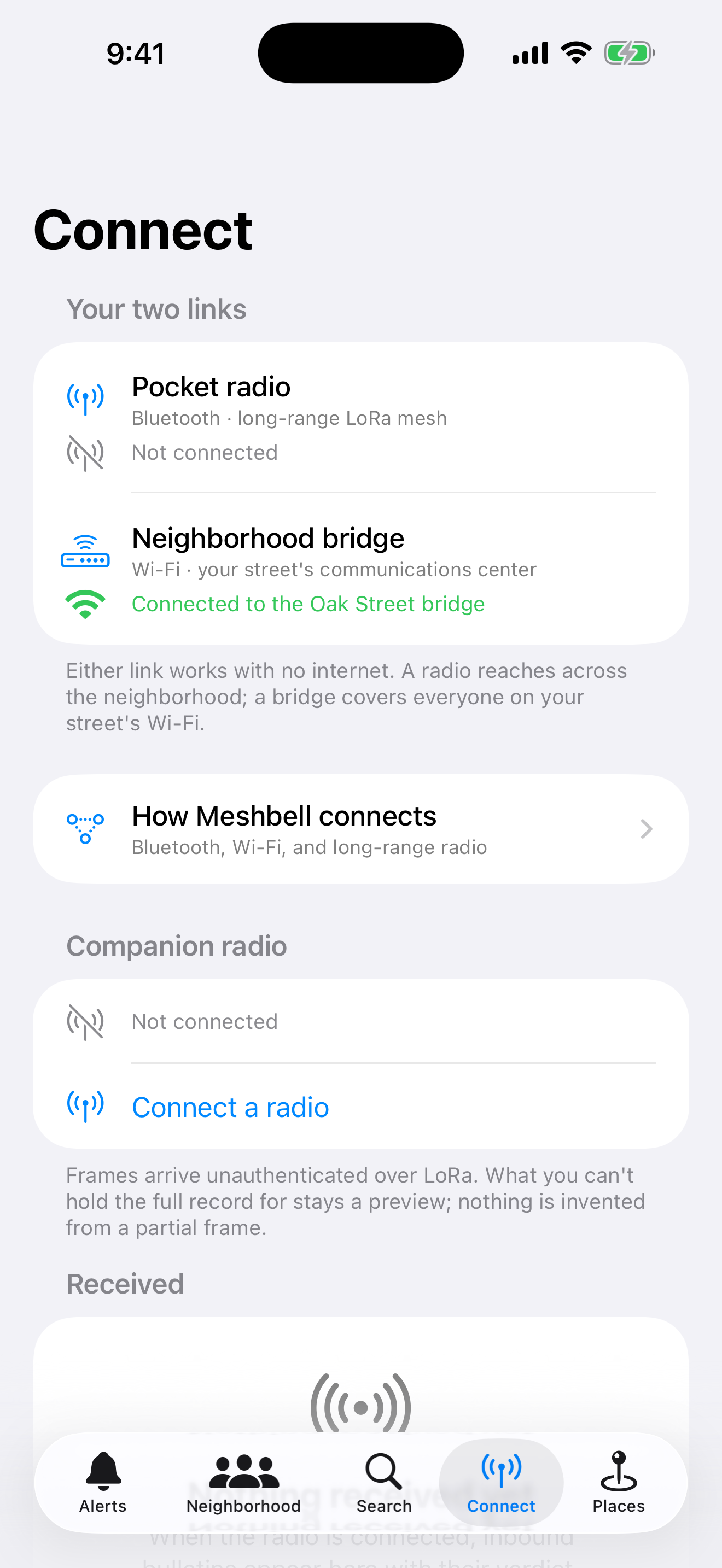
Walk out of range, reboot a radio, take interference. The connection re-establishes and keeps listening while the app is open. A companion radio serves one phone at a time, and the app says so instead of spinning.
- offline
Degraded is the normal state
An old phone, a dying battery, no cell and no Wi-Fi. It keeps working, and it labels stale data with its age.
Coordination layer
Once everyone is safe, run the logistics.
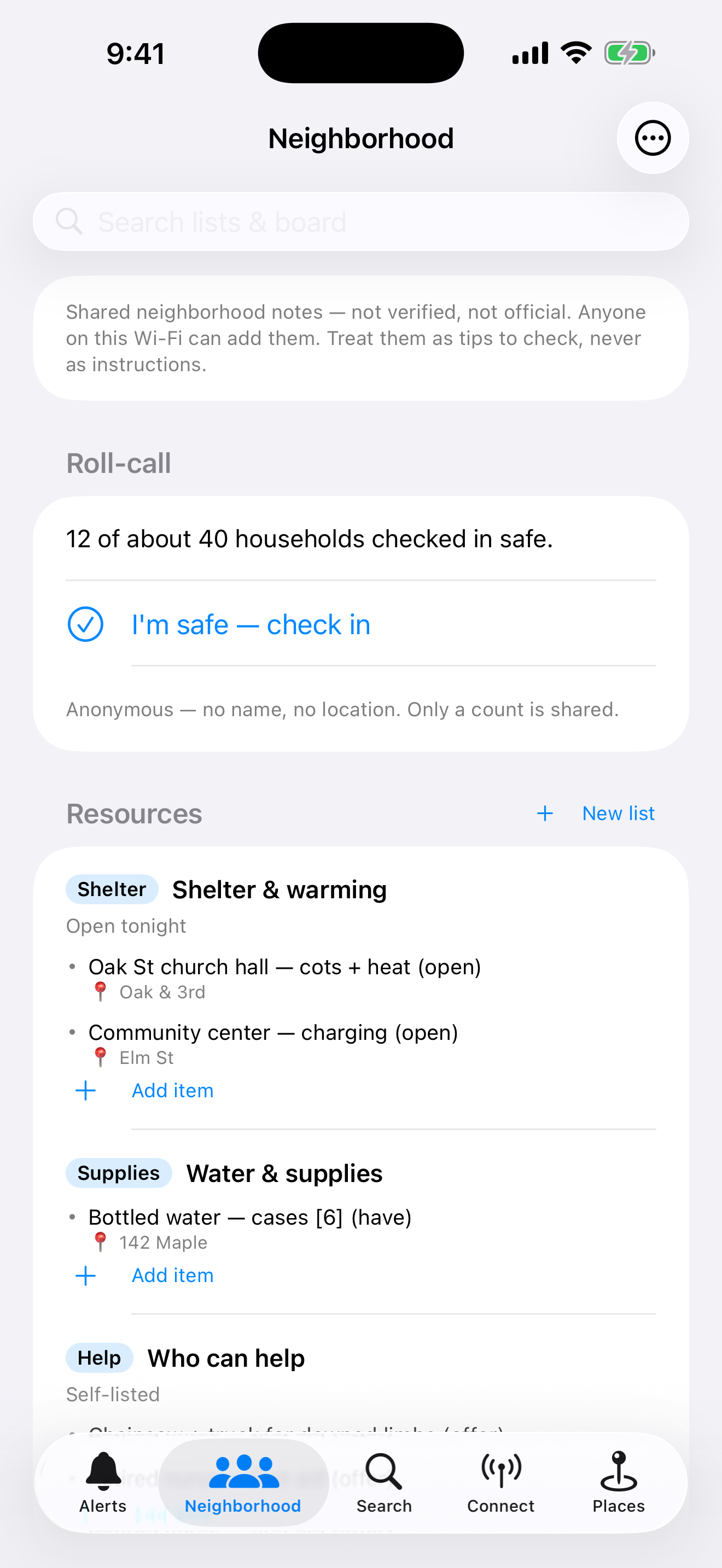
A Neighborhood tab next to Alerts, carried by your street's bridge over local Wi-Fi. No browser, no account, no internet.
An anonymous roll-call
One tap to check in safe. Everyone sees a running count and nothing else: 12 of about 40 households checked in. No names, no addresses, no locations, no map of who is home. The count stays hidden until a handful have checked in, so no single household can be picked out of it.
Shared resource lists
Shelter and warming spots, water and supplies, power and charging, and a self-listed who can help: the neighbor with a chainsaw, the nurse two doors down. Anyone on the bridge can add and edit. Nobody is added by someone else.
A board, sorted by channel
Offers, requests, questions and updates, each tagged to a channel and windowed by how recent it is, so a busy street stays scannable. You post under whatever name you type.
A paper fallback
When phones die, the bridge prints one page to tape to a door.
Bridge printout
roll-call · 12 of ~40 safe
water · fire station, 6th st
shelter · elementary school gym
board · generator free to borrow, ask at 214
Shared notes, not verified alerts. The coordination layer is unverified by design and sits beside the signed alert rail, never inside it. Neighbors write it, so treat it the way you would treat a note taped to a door: useful for logistics, never a source of official instruction.
Screens
Clear enough for the worst day.
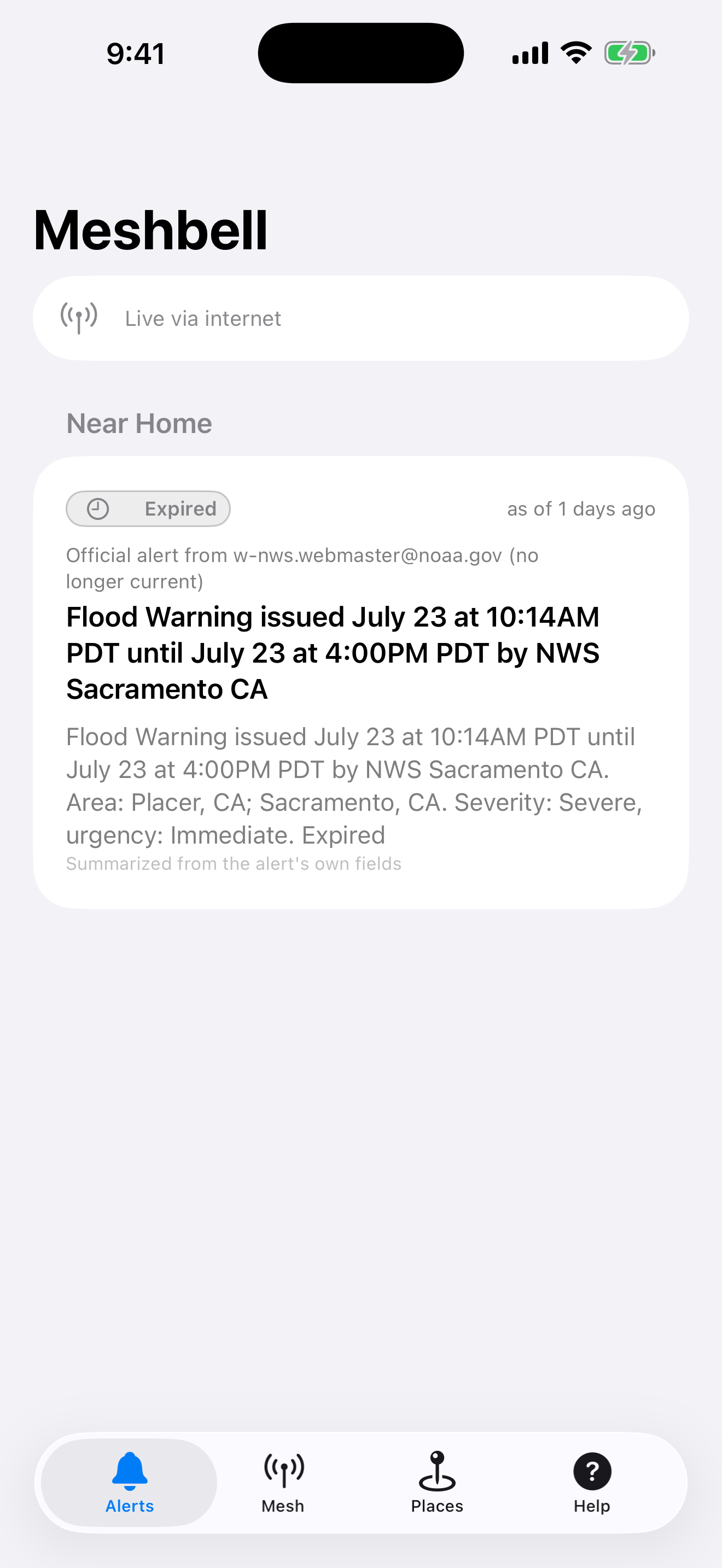
One bottom bar: Alerts, Neighborhood, Search, Connect, Places. Plain language Help is one tap away on Alerts.

The line we do not cross
The app never launders a rumor into an instruction.
Most apps show you a claim and let the styling imply it is true. Meshbell keeps two facts apart and visible: who is speaking, and whether this device could check them. A neighbor's unconfirmed report is shown as exactly that. Only a message that clears a real cryptographic bar can carry an instruction, and even a relayed official alert is not treated as official here.
Unverified is not red. It is grey, because it means unknown, and a forgery and a key you have not met yet are two different facts. Collapsing them into one word would hide the distinction a person actually needs.
- Verified
- Could not be verified
- Relayed official
Nonprofit
A public good.
Meshbell is built as a nonprofit and the alerting is free. We will not sell your emergency, put a life-safety feature behind a paywall, or turn your neighborhood into a mailing list.
Support and low cost hardware pay for radios and bridges, never for the alerts.
Status
Where this actually stands.
Open TestFlight beta for iPhone, feature complete on the phone as it heads toward 1.0.
A signed bulletin has crossed real LoRa radios at 910.525 MHz and verified on a phone, offline. That is one hop on a bench, not a neighborhood at scale.
A new build can take a while to clear Apple's beta review before it will install.
Meshbell is not a replacement for official emergency services. Keep the alerts you already have turned on.